Live Project
ProCreator x Arthan Finance
AI Square:
Loan Operations
Platform

WHAT IS THE PRODUCT
An internal mobile-first loan operations platform built to manage the end‑to‑end lifecycle of business loans.
THE CORE PROBLEM
Loan operations were manual and fragmented across roles, poor visibility between teams, delayed decisions, and avoidable operational overhead.
OUTCOME
We designed a unified system that connected field, branch, and credit workflows into a single product, reducing coordination friction and enabling faster loan processing.
01
Problem Framing
At the outset, this project appeared to be a straightforward digitization effort: replace physical loan workflows with a mobile and web application. That framing turned out to be incomplete.
As I dug into day‑to‑day operations, it became clear that the real challenge wasn’t speed or usability in isolation, but how decisions made by one role directly shaped the workload, priorities, and outcomes of others.
This inter-dependency created cascading problems:
Small errors or delays upstream, multiplied downstream
Teams lacked shared context on the status of the leads
Manual follow‑ups became the default coordination mechanism
The problem, therefore
Was not just to design screens or flows, but to create a system that could tolerate ambiguity, surface dependencies, and reduce the cost of coordination across roles, even when not every actor or edge case was fully known upfront.
02
Users, Interviews & System Roles
I conducted qualitative interviews with the three primary roles involved in daily loan operations: Relationship Managers (RMs), Branch Managers (BMs), and Branch Credit Managers (BCMs). Given the internal nature of the product and a tightly scoped user base, interviews were the most effective way to surface workflow breakdowns and hidden dependencies.
The findings were synthesized using affinity mapping to identify patterns across roles.
RM [Field]
BM [Branch]
BCM [Hybrid]

Primary responsibility
RMs operate in the field, sourcing leads, collecting customer information, and initiating loan applications.
What we heard in interviews
Lead progress tracking was time‑consuming and fragmented
Too much paperwork and manual data entry in the field
Difficulty tracking pending work and follow‑ups
Limited awareness of what other team members were working on, leading to overlap
Downstream Compliance & Disbursal Roles
These roles were introduced later in the project, primarily on the web platform, and were not part of the initial interview set. The focus was on building structures that were predictable, auditable, and resilient to incomplete information.
03
Research
Reframing
The interviews and affinity mapping showed that the core issues were not isolated usability problems, but breakdowns that occurred when work moved between roles. Delays, rework, and confusion consistently surfaced at points of dependency rather than within individual tasks.
SHIFT 1
From role-centric to system-centric
The focus moved from optimizing individual roles to making the movement of information, decisions, and accountability clear across the system.
SHIFT 2
From task completion to coordination cost
The biggest friction came from follow-ups, ambiguity, and manual syncing between people. Reducing this coordination overhead became a core success measure.
SHIFT 3
From perfect knowledge to resilient structure
With downstream compliance and disbursal roles introduced later, the system needed to function even with partial information, favoring predictable and consistent structures.
04
System Thinking & Information Architecture
Once the problem was reframed as a coordination issue across roles, information architecture became the primary design lever. The focus shifted to creating a shared structure that made state, ownership, and next actions clear across the system.

DECISION 1
A shared structural backbone across RM, BM, and BCM workflows, with role-specific emphasis layered on top

DECISION 2
An extensible navigation model that could scale beyond loans to future financial products

DECISION 3
Treating leads as a single evolving entity, surfaced consistently across different touch points

DECISION 4
Reusing core patterns when the web platform and downstream roles were introduced late in the project
05
Deep Dives
Each story below represents a distinct, high‑impact problem that shaped the product.
Deep Dive 01
Designing for Persona Interdependencies
Problem in the Real World → Reframing
Loan processing at Arthan depended on close coordination between RMs, BMs, and BCMs. In practice, actions taken by one role often created invisible consequences for others. A rejected lead, a clarification request, or a delayed approval frequently surfaced only after downstream work was blocked.
What initially appeared to be isolated workflow issues across roles was actually a visibility and dependency problem.
Design Strategy & Key Decisions
The strategy was to make inter-dependencies explicit without overwhelming users.
Three touch-points were intentionally distributed across places users already checked during the day:
Notifications as the fastest signal, allowing users to quickly spot blocked, rejected, or clarification-needed leads without context switching. Notifications were grouped by priority and use case to avoid noise.
Lead pipeline & activity timelines to provide a continuous view of lead status, showing exactly when changes occurred so users could plan follow-ups and daily work more deliberately.
Dashboards and lead detail views to surface unfinished tasks alongside full historical context, ensuring accountability while preserving access to the complete lead narrative.
As an additional fallback, all roles could directly search for specific leads or users, with BMs and BCMs able to filter results by the RM responsible, ensuring blocked or unclear cases were still discoverable even if earlier signals were missed.
Resulting System Behavior
With these changes in place:
RMs immediately see when their leads are blocked, rejected, or need clarification
BMs can identify bottlenecks caused by pending actions across the branch
BCMs gain clearer upstream context, reducing rework and unnecessary follow-ups
Interdependencies become visible and actionable, reducing stalled work and misaligned effort across roles.
Deep Dive 02
Reducing BCM Travel Time
Problem in the Real World → Reframing
Branch Credit Managers (BCMs) spent a large part of their day traveling for compliance-related tasks. In practice, these visits were poorly sequenced, leading to unnecessary back-and-forth travel and little visibility into how daily tasks connected.
Design Strategy & Key Decisions
The strategy was to convert a physical, manual workflow into a system-driven one that could actively support decision-making in the field.
Key decisions:
Treat BCM tasks as a connected set of daily objectives, not independent visits
Introduce route-aware task sequencing, rather than static task lists
Allow flexibility through manual overrides, acknowledging real-world constraints like customer availability
Resulting System Behavior
With these changes in place:
BCMs receive a pre-configured daily route that minimizes redundant travel
Tasks are sequenced based on location and readiness, reducing back-and-forth movement
Deviations can be handled without breaking the overall plan
Deep Dive 03
Motivating RMs to Meet Targets
Problem in the Real World → Reframing
Branch Managers consistently struggled to meet branch-level targets because Relationship Managers (RMs) were not maintaining steady daily performance. Activity levels fluctuated, follow‑ups were inconsistent, and effort often spiked only near reporting deadlines.
The interviews revealed that: RMs lacked continuous visibility into their own progress and how their daily actions contributed to branch outcomes. Motivation broke down not because rewards were missing, but because feedback and progress signals were delayed or absent.
Design Strategy & Key Decisions
The strategy focused on making progress visible, comparable, and continuous rather than relying on one‑time rewards.
Key decisions:
Shift from end‑of‑month incentives to daily and weekly progress feedback
Use lightweight competition to create social accountability without punitive pressure
Make performance transparent to both RMs and BMs to align expectations
Instead of treating motivation as a gamification layer, it was designed as a system feedback loop embedded into everyday workflows.
Resulting System Behavior
With these changes in place:
RMs can see their daily progress, rankings, and milestones in real time
BMs gain visibility into individual and branch‑level momentum
Performance becomes more consistent, not just deadline‑driven
The system moves from reactive performance tracking to continuous motivation through visibility and feedback.
Deep Dive 04
Designing a Web Platform for Largely Unknown Stakeholders
Problem in the Real World → Reframing
Towards the end of the project, a web platform was introduced for downstream compliance and disbursal stakeholders who entered the workflow post-approval. These users were outside the original research scope, with limited access and tight timelines.
Design Strategy & Key Decisions
With only a month remaining and no realistic way to design every desktop flow end-to-end, the strategy shifted from completeness to structural coverage and reuse.
Key decisions:
Establish a new desktop IA, while staying aligned with the mobile design language and core system structures.
Start with very low-fidelity wireframes to quickly lock layout, hierarchy, and system structure instead of spending time on high-fidelity detail
Identify and design only structurally unique screens, allowing developers to reuse and adapt them across similar flows
Resulting System Behavior
With this approach:
Web users encounter familiar structures that mirror mobile workflows
Handoffs from mobile to web remain consistent and traceable
06
Final Designs
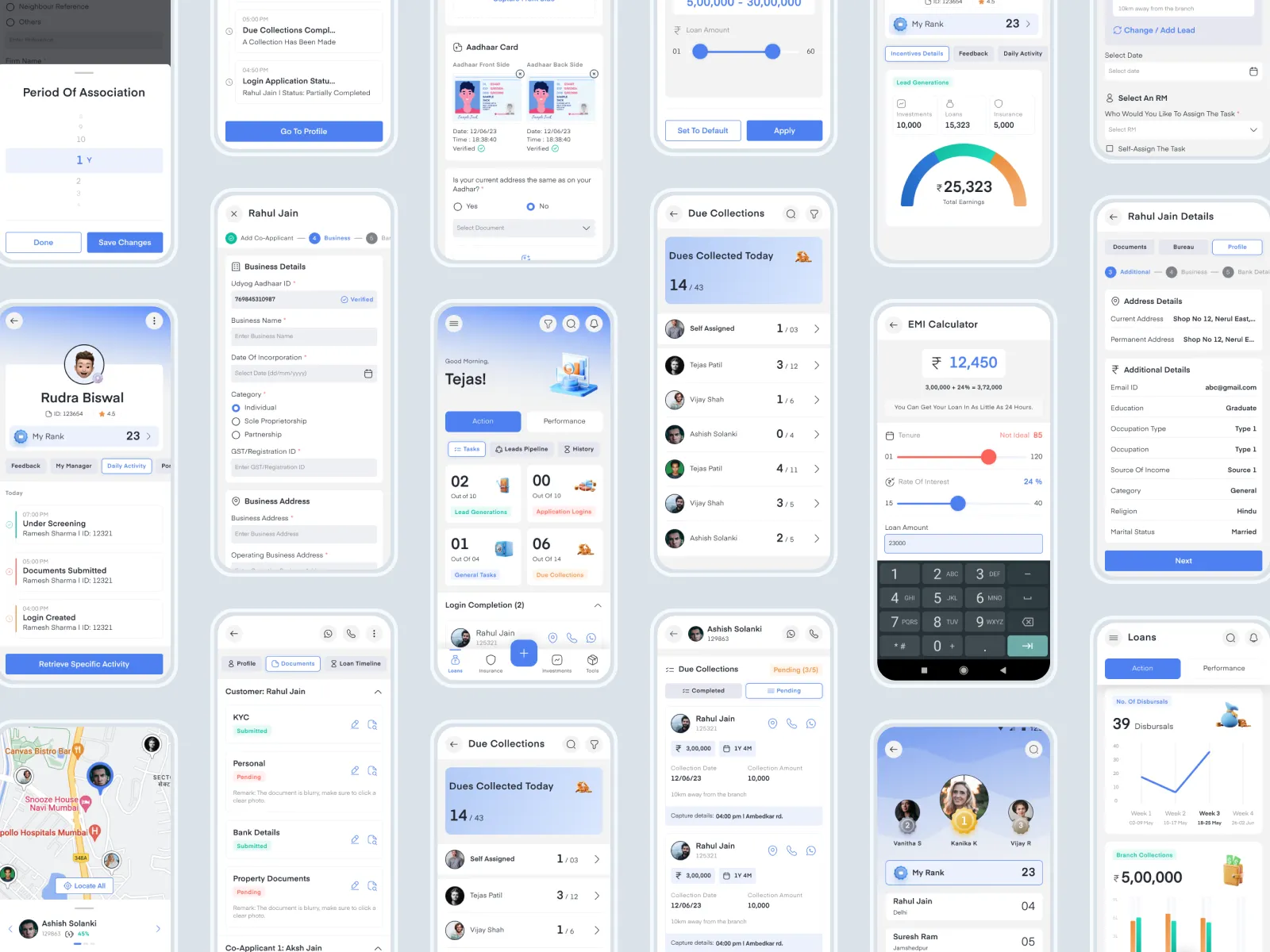
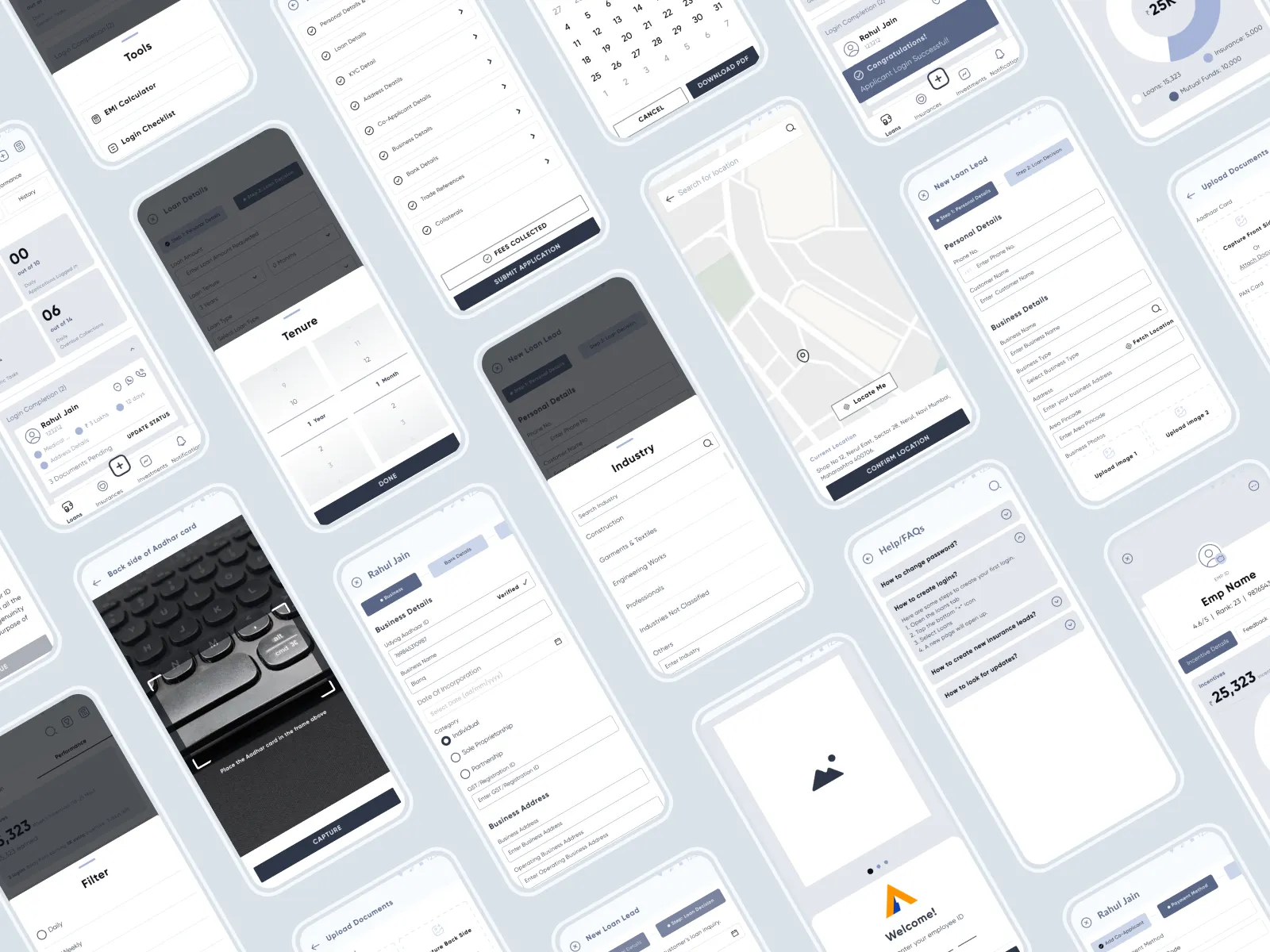
This section highlights the transition from wireframes to final designs across both platforms
Mobile
Web
07
Outcomes & Signals
Due to the internal nature of the product and ongoing rollout, quantitative metrics were unavailable at handoff. However, we received operational signals and stakeholder feedback.
Branch Managers (BMs) shared that the platform significantly simplified branch-wide coordination, enabling them to allocate resources more effectively.
Users praised the intuitive and modern interface, noting that it reduced the learning curve during the pilot rollout.
The gamification features, such as leaderboards and badges, has received a positive response.
Relationship Managers (RMs) reported that task tracking through the performance dashboard streamlined their daily workflows.