Canvas by Instructure
University of Michigan
Canvas:
Rethinking Why
Students Leave
Role
Researcher
Team
5 Members
Timeline
~4 Months

THE PROJECT
A semester-long research collaboration with Instructure to understand why high-school graduates are choosing alternative pathways over college.
THE PROBLEM WASN'T ENROLLMENT. IT WAS DISENGAGEMENT
Students weren't opting out because of cost. They were checking out long before financial aid ever came up.
THREE DIRECTIONS FOR CANVAS
A research-backed reframe and three platform-level concepts designed to rebuild curiosity before students walk away.
01
The data pointed at finance. We assumed it was right.
Instructure brought us a broad brief:
College enrollment is declining, and more students are choosing alternative pathways after high school.
Tuition increase over a decade
37%
rise in cost of attendance
Graduates carrying debt
60%
leave school with student loans
Community college attendance
falling, even as the "affordable" option
The numbers described what was happening. They didn't explain why.
02
Users only mentioned money when we asked about it.
I led the interview sprint — structuring the plan, coordinating logistics, and splitting facilitation across the team. We each ran multiple sessions, then interpreted the data together.
We spoke to recent graduates who'd chosen alternative pathways and high-school counselors. Finance came up, but only when prompted. Unprompted, students talked about boredom, irrelevance, not knowing what they wanted.

By the time we're talking about financial aid, many students have already checked out emotionally.
— High school counselor
Money was a justification. Disengagement was the cause.
03
We reframed before we ideated.
Before committing to a new direction, we brought the finding to Instructure. It aligned with their own research. They also defined the constraints we'd need to design within: scalable across institutions, feasible within Canvas, no increase to instructor workload.
Original HMW
How might we help students overcome financial and motivational barriers to higher education?
Focuses on cost and constraints
New HMW
How might we make learning engaging enough that students discover genuine interest and feel inspired to pursue higher education?
Focuses on motivation and engagement
* HMW statements have been condensed for clarity.HMW statements have been condensed for clarity. The original formulations were more detailed, capturing additional nuance around target audience, barriers, and intended outcomes.
04
20 ideas. 3 made it.
We generated over twenty ideas without a feasibility filter, then voted — with one rule: you couldn't vote for your own. Six advanced, evaluated using a Pugh Matrix against four criteria defined by Instructure.
PUGH MATRIX - EVALUATION CRITERIA
Motivation Impact
Does it meaningfully increase student engagement and curiosity?
Scalability
Can it work across institutions without heavy customization?
Instructor effort
Does it add to instructor workload, or work without them?
Time-to-build
Is it feasible within Canvas's existing infrastructure?
THE HARDEST CUT
Virtual Client Project Hub
Real-world challenges from partner organizations, submitted through Canvas. Strong on motivation and impact — nearly the whole team backed it. But it needed institutional partnerships and infrastructure Canvas didn't have yet.
Did not advance because of "Time-to-build"
05
what made it though could work within canvas today.
Each concept is independent in use case, but all three were designed with the same underlying goal — moving students along a single arc.
The design philosophy behind all three concepts
Stage 1
Curiosity
Stage 2
Motivation
Stage 3
persistence
1
Personalized Dashboards
A student-owned space within Canvas. Customizable layout, goal-setting, utility widgets. Fully optional — respects institutional culture while giving students a sense of belonging.


2


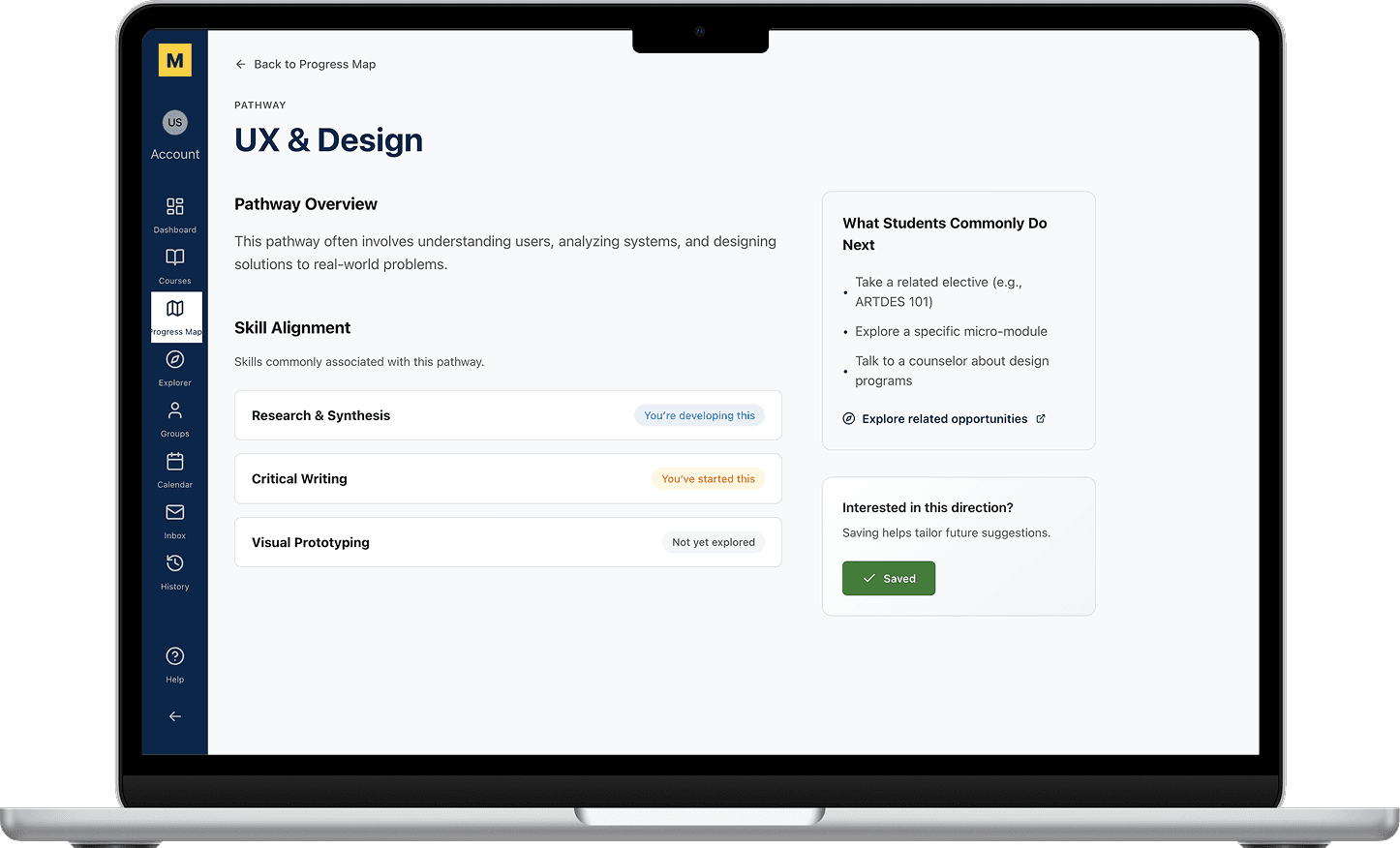
Progress Maps & Skill Pathways
Learning visualized as skills building toward real outcomes — not just grades. Students could see what they were becoming, not just what they'd completed.
3
Interest-Exploration Micro-Modules
10–20 min scenario-based modules embedded in Canvas. Low instructor effort via AI-assisted creation. Direct pathways to counselors or alumni when interest sparks.


06
The output was a reframed problem, not a shipped feature.
This was a research and strategy project. Nothing went into production. But the output was a validated directional recommendation, grounded in primary research, stress-tested against Instructure's real product constraints, and presented back to the client.
WHAT MADE IT REAL
Grounded in primary research
Validated against product constraints
Presented to the client
Aligned with Instructure's own findings
THE PIVOT WAS THE WORK
Instructure could have received a set of financial aid features. They received a reframed problem instead.
One that pointed at where Canvas could actually make a difference, not just where the problem appeared loudest in the data.
07
What I'd do differently.
1
Interview more instructors.
We had limited access to them, but they're the ones who decide whether anything we proposed actually sees the inside of a classroom. Understanding their constraints earlier would have sharpened our feasibility thinking.
2
Push harder on one concept.
Equal weight across three directions was the safe call for an academic deliverable. In a real product context, I'd want to go deeper on Micro-Modules, it's the most novel, the most directly tied to the core insight, and the one most worth pressure-testing.